
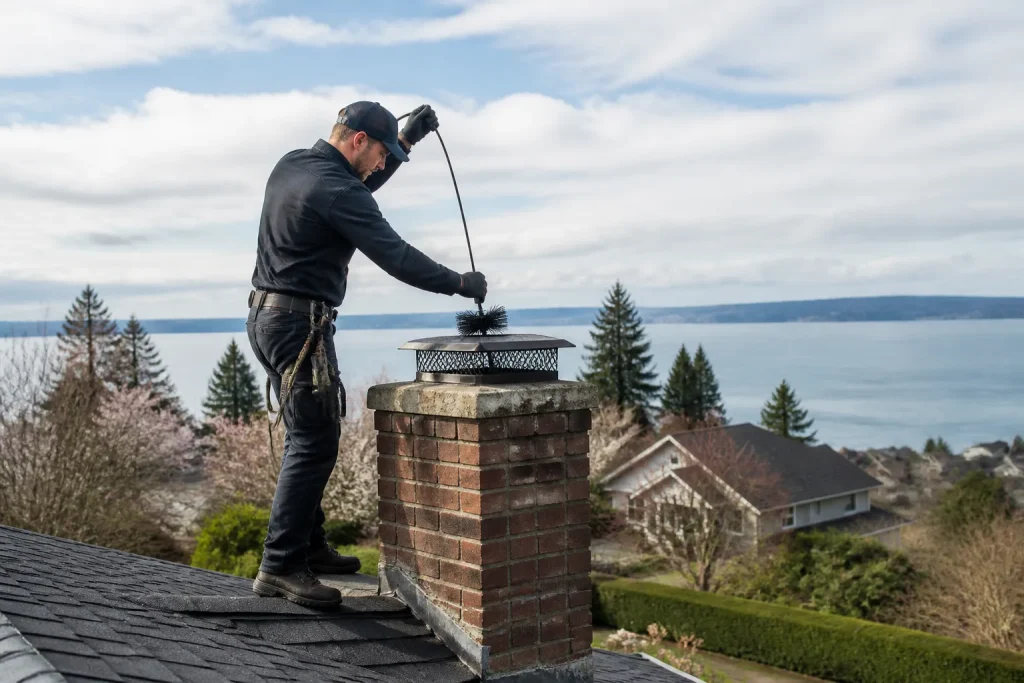
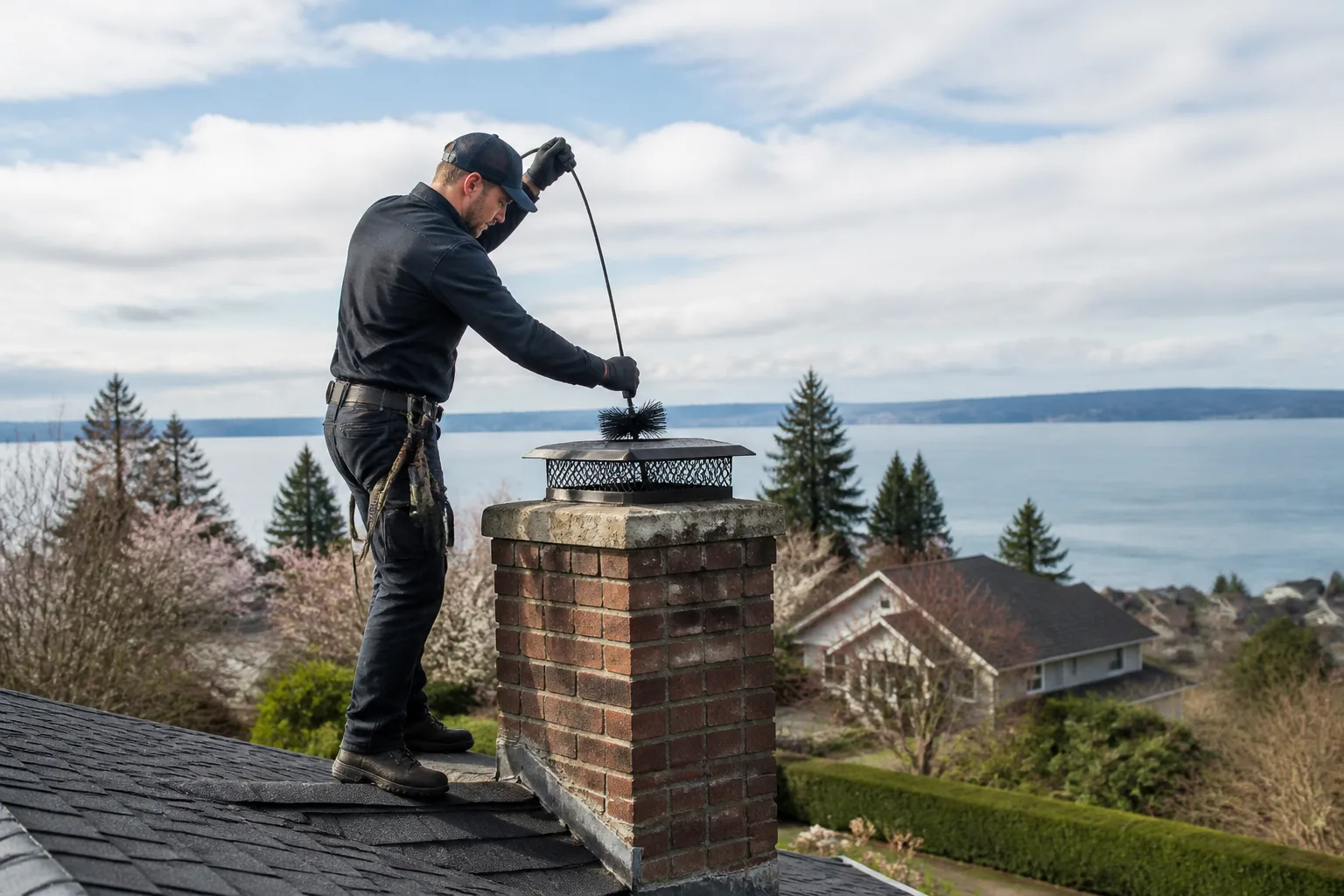
How to Choose the Right Chimney Cleaning Company in Edmonds
Most people pick a chimney company the way they pick a plumber: whoever answers the phone first. That’s the mistake. Washington State doesn’t license chimney sweeps separately from general contractors, so anyone with a brush and a van can legally advertise chimney cleaning here. The credential that actually tells you whether a company knows what it’s doing is CSIA certification, and a lot of the companies advertising around Edmonds don’t hold it. Below is how to check.
If you’d rather skip the vetting and talk to someone who does this work every day, call us at (855) 726-7158. Estimates are free.
Why Edmonds Homeowners Need to Vet Carefully
Chimney cleaning looks simple from the outside. A brush goes down a flue, soot comes out, and the technician leaves. That’s the version a cleaning-only outfit sells, and it’s not wrong so much as incomplete. A chimney is a system: firebox, damper, flue liner, cap, crown, and the flashing where it meets the roof. Cleaning addresses one part of that system. Diagnosis addresses all of it.
What separates a diagnostic company from a mechanical one is what happens after the sweep. A technician who inspects before recommending anything will tell you what condition the flue liner is in, whether the crown has cracked, and whether the cap is keeping water out. A technician who only cleans will tell you the chimney is clean.
In Edmonds, that difference matters more than in a dry climate. Masonry here lives in a marine environment: wet winters, salt-laden rain, and enough damp that brick and mortar stay saturated for long stretches. A hairline crack in a crown or a missing cap that would be harmless in eastern Washington becomes a slow water path into the chimney structure here. Water intrusion and freeze-thaw cycling are the two most common causes of masonry failure we see in Edmonds, and neither shows up during a cleaning.
Our technicians have up to 14 years of experience, and the thing that experience drills into you is this: the visible firebox tells you very little. The problems live above it.
How Do You Verify CSIA Certification in Edmonds?
You check the CSIA directory directly, not the company’s website. The Chimney Safety Institute of America maintains a searchable list of certified sweeps, and it’s the only credential in this trade that means anything. Here’s how to use it.
- Ask the company for the full name of the certified technician who will do the work. Certification is held by individuals, not companies.
- Search that name in the CSIA directory before you book.
- Confirm the status reads active, not lapsed or expired. A lapsed certification means the technician stopped renewing, and the credential no longer reflects current training.
- Ask whether the company also carries general liability insurance. Washington doesn’t require a separate chimney license, so insurance is your other protection.
What CSIA certification covers that contractor licensing doesn’t: NFPA 211 code compliance, inspection categories (Level 1, 2, and 3), venting principles, clearance-to-combustible requirements, and liner condition assessment. A general contractor’s license tells you someone registered with the state and paid a fee. A CSIA certification tells you someone was tested on how chimneys actually work.
If a company can’t or won’t name a certified technician, that’s your answer. Move on.
Five Questions to Ask Before You Book
A five-minute phone call reveals whether you’re talking to a diagnostic operation or a cleaning service with a brush. Ask these, in this order, and listen to whether the answers are specific.
- “What level of inspection do you perform, and does it include the flue liner?” You want to hear “Level 1 and Level 2” and a clear explanation of what each covers. A Level 2 inspection includes video scanning of the flue, which is the only reliable way to assess liner condition.
- “Do you provide a written report with photos or video?” A company that diagnoses properly documents what it finds. If the answer is “we’ll let you know if anything looks off,” there’s no record you can evaluate or compare against a second opinion.
- “What happens if you find a cracked liner?” Listen for options: resurfacing with HeatShield for liners that qualify, a flexible stainless liner using a system like DuraFlex for those that don’t, and an honest explanation of which applies to your chimney and why.
- “Do you handle cap and crown work?” These are the top two points of water intrusion on any chimney. A company that cleans but refers crown repair elsewhere leaves you coordinating two contractors on one structure, which is exactly how problems get missed.
- “What does the estimate cover, and will the price change after you arrive?” You want a written estimate set before the work begins, not a number that moves once the technician is in your driveway.
A cleaning-only company will struggle with the first three. Those questions are designed to surface that early, before anyone is on your roof.
Why a Full-Lifecycle Chimney Company Is Structurally More Trustworthy
Think about incentives. A company that only cleans has one revenue stream: cleaning. That doesn’t make every sweep-only operator dishonest, but it does mean the company isn’t set up to notice, document, or fix anything beyond soot. It may genuinely not have the equipment to scan a flue, which means it can’t find what it isn’t looking for.
A company that handles the full lifecycle has a different structure. Cleaning, inspection, fireplace repair, chimney repair, cap and crown installation, and liner work all sit with the same team. That matters for three reasons:
- Nothing gets handed off. The person who finds a cracked crown during inspection is the person who quotes the repair. No translation loss between contractor A’s findings and contractor B’s estimate.
- Diagnosis drives recommendations. When repair is part of your business, the inspection is your own cost center, not a courtesy. You document what you find because you’re accountable for what happens next.
- Materials are trade-spec. Companies that do structural repair work buy professional-grade products, the brands the trades rely on, rather than hardware-store substitutes. Famco venting components and Copperfield flashing and weatherproofing products exist because installers need them to hold up. A cleaning-only outfit never needs either.
The test is simple: ask who handles it if they find a damaged liner. If the answer is “we refer that out,” you’re about to become a project manager. If it’s “we do,” you have one point of accountability from the firebox to the crown.
What Should a Local Chimney Specialist Know About Edmonds?
Local knowledge is hard to fake on a phone call, and it shows up in whether a company’s recommendations match how chimneys actually fail here. A few markers to listen for:
- Masonry behavior in a marine climate. Wet winters and saturated brick mean crown cracks and flashing gaps become structural problems, not cosmetic ones. A specialist here should talk about waterproofing and drainage without being prompted.
- Wood species burned locally. The Puget Sound area burns a lot of alder, Douglas fir, and maple, plus the occasional seasoned hardwood brought in from elsewhere. Alder burns hot and fast; fir carries more creosote when it’s not well seasoned. Which species you burn affects how often your flue needs sweeping, and a technician who knows the local wood supply can give you a realistic interval instead of a boilerplate “once a year.”
- Flue sizing in older homes. Many Edmonds houses were built with fireplaces that were later fitted with inserts or converted to gas. Oversized flues are a common problem: a big clay liner trying to vent a smaller appliance cools too fast, which accelerates creosote deposition and can affect draft. If a company never mentions flue sizing, it isn’t thinking about your whole system.
Our team works across the North Sound and knows how these chimneys age in this climate. From the firebox to the crown is the only way we’ll assess one.
How to Read Reviews for Chimney Services
Review counts and star averages tell you less than the language inside the reviews. For chimney work specifically, look for these phrases, which signal a real inspection happened:
- “They showed me photos of…” or “video of the inside of the flue.” That’s a company that documents findings.
- “They told me I didn’t need…” or “said it could wait.” A diagnostic company that talks you out of unnecessary work is the strongest signal in the category.
- “They explained why…” followed by an actual technical detail, not just “great service.”
- “Fixed the cap” or “repaired the crown.” Evidence of scope beyond cleaning.
Be wary of reviews that describe only speed, price, or friendliness. Those are fine, but a quick brush-and-leave visit also generates them. If a review says “in and out in twenty minutes,” that may be efficient, or it may mean no inspection occurred. Twenty minutes is short for a proper sweep plus a Level 1 or Level 2 assessment of a chimney’s condition.
Read the negative reviews too, but read them for pattern. One complaint about scheduling is noise. Repeated mentions of “found a problem and pushed for expensive work” or “wouldn’t give a written estimate” is a signal.
If you’re due for an annual visit anyway, start with a chimney sweep and ask for the inspection report that comes with it.
What happens when you call
- 1
A real person answersNo phone trees – you reach a local pro.
- 2
You get an upfront price rangeHonest numbers before anyone is dispatched.
- 3
A background-checked tech heads outLicensed & insured, dispatched right away.
- 4
You approve before work beginsNothing starts until you say go.
When to Call a Pro
Some chimney maintenance is genuinely DIY-adjacent: checking that your damper opens fully, keeping the firebox clear of ash, and making sure the cap is actually on there. That’s about the ceiling. Once you’re talking about the flue interior, the crown, or the liner, it’s a trained-professional job. Creosote is flammable and the flue is a confined space; there’s no safe spectator version of that work.
If your fireplace smells like smoke when it’s not lit, if you see staining on the exterior brick, if a previous inspector flagged a liner issue, or if it’s simply been a few years since anyone looked, that’s the moment to call. A chimney that hasn’t been serviced in years is not a wait-and-see situation.
Related services in Edmonds: if cleaning turns up a problem, we handle fireplace repair and chimney repair with the same team that did the inspection, so nothing gets lost between the finding and the fix. For the annual visit itself, our Chimney Sweep Edmonds page covers what’s included.
The Bottom Line
Choosing a chimney company in Edmonds comes down to four checks: verify CSIA certification at the individual level and confirm it’s active, ask the five diagnostic questions before booking, prefer a company that handles the full lifecycle from cleaning through crown work, and read reviews for evidence of documented inspection rather than speed. Chimneys are systems, and a company that treats one as a single task will miss what matters.
We inspect before we recommend. That’s the order we work in, and it’s why we carry professional-grade materials like HeatShield resurfacing and DuraFlex liner systems: so an inspection finding can be resolved by the same team, without a demolition job where a repair will do.
If you’re in Edmonds and need help, Chimney Sweep Edmonds offers free estimates. Call (855) 726-7158 to book yours.
Frequently Asked Questions
No. Washington does not issue a separate chimney sweep or chimney specialist license. Washington’s general contractor registration covers registration as a contracting business, not chimney competency, and it doesn’t test anyone on NFPA 211 or flue inspection. The CSIA certification is the credential that actually verifies chimney knowledge, and it’s voluntary. That’s why you have to check it yourself. Call (855) 726-7158 if you want to talk through what to look for.
Ask for the name of the certified technician who’ll perform the work, search that name in the CSIA’s online directory, and confirm the status is active rather than lapsed. Certification belongs to the individual, not the company, so a company claiming certification should be able to name the technician immediately. If they can’t, treat the claim as unverified. Call (855) 726-7158 if you’d like an exact quote on a sweep, which is the usual starting point.
Most wood-burning chimneys need sweeping once a year, or more often if you burn frequently or burn unseasoned wood. The condition of your flue and how much creosote has built up matter more than a calendar. Gas fireplaces should still be inspected annually, because venting and liner issues don’t announce themselves. A professional assessment will tell you the right interval for your setup. Call (855) 726-7158 for an estimate.
An estimate should be free and set in writing before any work begins. The price is set per job once the type of chimney, access, and level of inspection needed are known, so anyone quoting a fixed dollar amount over the phone before looking has guessed rather than assessed. A written estimate protects you from a figure that moves after arrival. Call (855) 726-7158 for an exact quote.
Written by the team at Chimney Sweep Edmonds.
Need Chimney Cleaning Help?
Call Chimney Sweep Edmonds - the local pro we connect you with is licensed and insured, with free written estimates in Edmonds.
(855) 726-7158